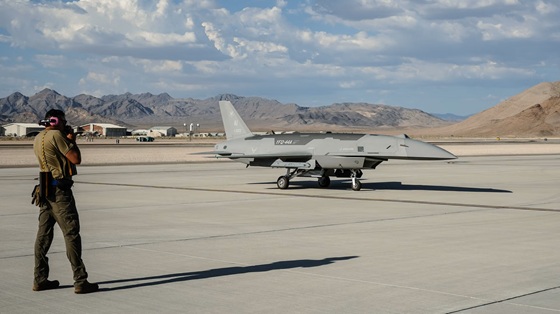
Anduril’s YFQ-44A autonomous combat aircraft has completed a second exercise with the U.S. Air Force’s Experimental Operations Unit, with Air Force personnel taking greater responsibility for mission execution and autonomous flight operations. Separately, the U.S. Army has demonstrated Anduril’s ALTIUS-700 launched from an H-60M Black Hawk as part of a networked reconnaissance and strike sequence.
The YFQ-44A exercise took place at Creech Air Force Base in Nevada and is part of the U.S. Air Force’s Collaborative Combat Aircraft (CCA) program. The program is developing semi-autonomous uncrewed aircraft intended to operate alongside crewed combat aircraft.
During the exercise, Air Force operators tasked the YFQ-44A during different phases of missions from multiple locations. According to Anduril, this distributed approach is being tested as a way to operate Collaborative Combat Aircraft without requiring a large number of personnel to be concentrated at a single base. Operational personnel also directly supervised daily mission-autonomy flights for the first time, during which the aircraft carried out tactics and manoeuvres relevant to future operational use.
The exercise built on an earlier event at Edwards Air Force Base in April, when personnel from the Experimental Operations Unit launched, recovered and maintained the YFQ-44A. The latest exercise placed more responsibility in the hands of operational Air Force personnel rather than development engineers and test crews.
The U.S. Air Force said the multi-day exercise at Creech generated multiple sorties and included integration with crewed aircraft in the local airspace. Personnel also practised servicing, refuelling and preparing the aircraft for additional sorties. Images released by the Air Force showed crews loading inert AIM-120 air-to-air missiles onto a YFQ-44A as part of work to determine the logistical requirements for operating the aircraft from remote or forward locations.
The Air Force describes the YFQ-44A as a semi-autonomous aircraft. The aim is not simply to test whether the aircraft can fly autonomously, but also to establish how operational units will plan missions, maintain the aircraft, control multiple systems and integrate them with existing combat aircraft.
ALTIUS-700 launched from Black Hawk
Anduril is also involved in a separate U.S. Army effort to integrate autonomous uncrewed aircraft with helicopters. Footage released by the company on August 31 shows an H-60M Black Hawk conducting a rocket-powered launch of an ALTIUS-700 during Project Convergence Capstone 6 at Fort Irwin, California.
According to Anduril, an ALTIUS-700 “hunter-killer” team was used to autonomously locate a target, share information between aircraft and carry out a strike. The demonstration formed part of the Army’s broader Air-Launched Effects program, which is intended to allow helicopter crews to deploy uncrewed aircraft for reconnaissance, electronic warfare, communications and strike missions while remaining farther away from defended areas.
The Army reported that H-60M crews launched and controlled multiple launched effects during the three-day Project Convergence exercise. The aircraft operated as part of a networked system in which the Black Hawk could also function as a communications node between airborne and ground units. The Army is simultaneously developing Long-Range Precision Munition, or LRPM, as the armed element of its launched-effects portfolio.
The Project Convergence test followed an earlier three-day exercise at Fort A.P. Hill in Virginia in June. During that event, Black Hawk crews launched and controlled multiple medium-range launched effects. The Army said the capability had been integrated into the helicopter during a 13-month development effort.
ALTIUS-700 is a modular uncrewed aircraft developed by Anduril following its acquisition of Area-I. Depending on its configuration, the aircraft can carry payloads for intelligence, surveillance and reconnaissance, electronic warfare, communications or other missions. Anduril says the non-weaponized ALTIUS-700 can remain airborne for up to five hours depending on its payload.
A separate ALTIUS-700M variant is configured as a loitering munition. Anduril states that the 700M can carry a warhead of up to 33 pounds and has a published range of up to 100 miles, or around 160 kilometres. The Army has previously used the ALTIUS-700 airframe as part of its medium-range Launched Effects development program.
Together, the YFQ-44A and ALTIUS tests illustrate two different approaches to military autonomous aviation. The Air Force is testing a larger semi-autonomous combat aircraft designed to operate alongside crewed fighters, while the Army is developing smaller launched effects that can extend the sensing and strike range of existing helicopters. In both programs, current testing is increasingly focused on how military personnel operate, maintain and coordinate the autonomous systems rather than on basic flight demonstrations alone.
Photo: Newsroom Anduril
