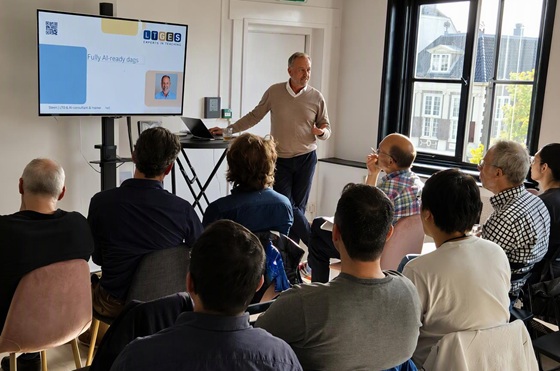
At the Leiden AI Community, FAIR data pioneer Barend Mons argued that the next step in artificial intelligence will depend less on ever larger models and more on the quality, meaning and accessibility of the data behind them. His answer is an infrastructure in which machines can understand data, algorithms travel to sensitive datasets instead of moving the data itself, and conceptual models help AI systems distinguish plausible answers from statistical guesses.
Speaking at the Leiden AI Community, Barend Mons returned to an idea that predates the current generative AI boom: making data understandable not only to people, but also to machines. The molecular biologist and professor at Leiden University and its Medical Center was one of the founders of the FAIR data movement, which developed the principles of making data Findable, Accessible, Interoperable and Reusable.
For Mons, however, the most important part of FAIR has always been machine actionability. He summarised the principle simply: “the machine knows what I mean.” In practical terms, concepts, structures and relationships in a dataset should have defined meanings that software can resolve without relying on human interpretation.
That requirement has become more relevant with the rapid adoption of large language models. According to Mons, even sophisticated AI systems remain dependent on the quality of the information supplied to them. Poorly structured, ambiguous or incorrect data can consequently propagate through AI systems and contribute to unreliable results and hallucinations.
From FAIR to Fully AI Ready
Mons therefore increasingly describes FAIR data as Fully AI Ready. A machine encountering a FAIR digital object should, he said, be able to determine three things independently: what the object is, what can be done with it, and what someone, or a machine, is allowed to do with it. These questions correspond respectively to its type, analytical metadata and governance metadata.
The distinction becomes particularly important in fields such as healthcare and life sciences, where terminology can be ambiguous and much of the most valuable information cannot simply be published openly.
Mons illustrated the problem with abbreviations and biological concepts that can have several meanings. Humans often resolve such ambiguity automatically through context. Computers require that meaning to be made explicit. He argued that AI models therefore need more than large quantities of text: they also need reliable semantic information that establishes what concepts mean and how they relate to one another.
One approach discussed during the presentation is to combine AI with large knowledge graphs and conceptual models. Mons referred to work in life sciences involving a graph containing around 4.5 billion triples derived from scientific publications and curated databases. Such a model can provide constraints on relationships between concepts and help determine whether an AI-generated proposition is semantically plausible.
This does not necessarily mean eliminating speculative results. Mons suggested that the strictness of such filters could depend on the application. Scientific discovery may benefit from allowing unusual hypotheses, while an operational system used in a high-risk situation may require much tighter constraints.
The result is what he described as a form of hybrid intelligence: machines identify patterns and generate possibilities, while structured knowledge provides context and boundaries.
Move algorithms instead of data
A second major part of the presentation concerned access to data. Particularly in healthcare, pharmaceutical research and other regulated environments, organisations may possess valuable information that cannot simply be copied into a central database.
Mons argued that the industry should therefore move from data sharing to data visiting.
In this model, data remains within a FAIR Data Station controlled by its owner or custodian. An algorithm travels to the data, executes locally and returns only an authorised result. The underlying dataset does not have to leave the organisation.
Access can be checked at several stages. A visiting algorithm can first negotiate permission, receive access to specified data and execute its task in a controlled environment. The organisation can subsequently inspect what the algorithm is trying to return and block the result if necessary.
Mons gave the example of pharmaceutical research into side effects. Instead of transferring patient records, an approved algorithm could visit hospital data and ask a narrowly defined question, such as how many patients received a particular drug, how many experienced a specific side effect and whether they belonged to a particular age group. The requester would receive the aggregated answer rather than the underlying patient records.
This approach is intended to make sensitive datasets usable for analysis while allowing their custodians to retain control. The same principle could potentially apply far beyond healthcare. During the presentation Mons mentioned applications involving areas including natural history collections, the Port of Rotterdam and government organisations.
An internet for machines
Mons compared the proposed architecture with the development of the internet. Rather than prescribing every application or infrastructure component, a relatively small set of common protocols could allow different systems to communicate.
LIFES, the Leiden Initiative for FAIR and Equitable Science, is intended to bring together the different parties required to build such an ecosystem. These include organisations that hold data, application and service providers, AI companies and expert communities that define standards and implementation profiles for particular domains.
The longer-term ambition is what Mons described as an “Internet of FAIR Data and Services” or a “Living Evidence Engine”: a distributed environment in which machines can find relevant sources, understand their meaning, negotiate access and perform analyses without requiring all information to be collected centrally.
For AI companies, this architecture could address one of the most persistent barriers to developing useful models: access to high-quality training and validation data. Mons concluded that LIFES wants to help create mechanisms through which companies can obtain controlled access to such data while data owners retain authority over how it is used.
The message to the Leiden AI Community was therefore that trustworthy AI is not simply a model problem. More capable algorithms still need data whose meaning can be understood, whose provenance can be established and whose use can be governed. In Mons’ vision, making that foundation machine-actionable may ultimately be as important to AI infrastructure as the models running on top of it.
