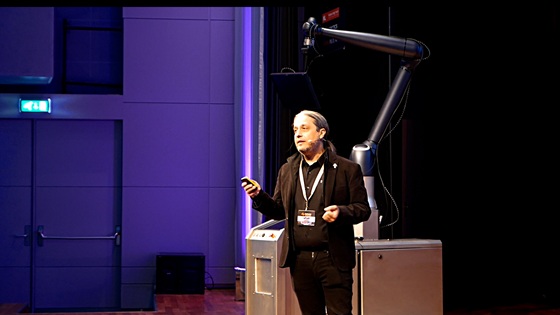
At the inaugural Future Pulse robotics convention in the Netherlands, hosted bt NLrobotics, Francesco Ferro, CEO and co-founder of PAL Robotics and president of euRobotics, delivered the opening keynote, addressing what is happening in robotics worldwide and what it means for Europe.
Ferro opened with a brief look at market projections, which point to trillion-dollar growth for the sector, numbers he noted are almost too large to fully grasp, and which are fuelling both excitement and anxiety across the industry. He also pointed to the International Federation of Robotics’ ongoing tracking of industrial and service robotics trends, noting that the organisation is preparing to publish its first dedicated humanoid robotics statistics in the coming weeks.
Geopolitically, Ferro described a technology race he would rather not frame as a race at all, since development should ultimately serve people rather than pit regions against each other. Even so, he laid out a clear picture: the United States is pushing hard to control the “brain” of AI and remains strong in robotics, though not always in hardware; China is scaling rapidly and, in Ferro’s view, is increasingly difficult to catch up with; and Europe, as usual, is starting later. He argued this isn’t necessarily a disadvantage — Europe’s slower, more methodical approach builds on stable foundations, step by step, and still has a meaningful role to play.
euRobotics: Connecting Europe’s Robotics Ecosystem
Ferro then turned to euRobotics itself, founded in 2012 through the merger of two long-standing communities, the academic research network EURON and the industry-driven European Robotics Technology Platform, EUROP — with a mission to connect academia, industry and policymakers across the value chain. The association counts roughly 250 members today, split between research and technology organisations and companies ranging from startups to established players, governed by a board evenly split between academia and industry.
He walked through several of euRobotics’ ongoing initiatives. Its topic groups, open to members and non-members alike, bring together people with shared interests, including a newly launched group dedicated to humanoid robotics, to collaborate on projects, most of which are privately funded to keep development moving quickly. euRobotics is also a founding member of ADRA, the AI, Data and Robotics Association, which succeeded the earlier EU-funded SPARC partnership as the private side of the European Commission’s public-private partnership. Every November, European Robotics Week sees the association capitalise on a decentralised celebration of robotics spread across roughly one to two thousand events continent-wide, while the European Robotics League runs hands-on competitions, one of which was hosted in the Netherlands earlier this year. And each spring the European Robotics Forum, deliberately structured as a forum of workshops rather than a conference, brings the community together to shape the field’s next steps; the 2027 edition heads to Birmingham, in the United Kingdom, from 2 to 4 March.
Ferro also pointed attendees to euRobotics’ strategic research and innovation agenda and to a statement issued at this year’s ICRA conference in Vienna, distilled into three principles. Robotics, the statement argues, should be human-centred, developed with and for people; it must be sustainable, a criterion Ferro said is increasingly demanded by investors as well as society; and it should be community-driven, built through open collaboration rather than any single actor trying to solve everything alone.
Inside PAL Robotics
Switching hats, Ferro walked through the evolution of PAL Robotics, the Barcelona-based company he co-founded in 2004, which now employs around 120 people with offices in France and Italy and plans to expand further this year. He traced the company’s path from early research prototypes, including a chess-playing robot and early healthcare platforms, through years of close collaboration with European universities, a relationship he says has become more challenging as low-cost platforms from China enter the market.
PAL Robotics now organises its work around three business units. In intralogistics, the company’s StockBot inventory robot uses RFID triangulation to track stock on shelves and is now deployed across some fifteen countries; its largest rollout to date has been with the sporting-goods retailer Decathlon. In legged robots, the company’s latest humanoid platform, Kangaroo, is deliberately headless. Ferro explained the design choice on both practical and safety grounds: the neck is a robot’s most fragile point in a fall, and removing the head frees up space to carry objects and expands the robot’s working envelope. The platform is trained largely through imitation learning in simulation, though Ferro stressed that translating that training into safe, controlled behaviour in the real world remains the hardest part. And in mobile manipulation, the wheeled TIAGo Pro — the latest evolution of PAL’s widely used TIAGo research platform — runs on ROS 2 and open-source software, supports interchangeable end-effectors from simple grippers to three-fingered hands, and now trains new manipulation behaviours in a matter of hours rather than days.
Three Closing Messages
Ferro closed with three points he said summarise his outlook on the sector. First, service robotics cannot be built by any single company, however large, because real progress requires collaboration. Second, the industry must resist building for spectacle: early humanoid demonstrations generated headlines and photo opportunities with politicians, but the harder and more important work is identifying and solving genuine user needs. Third, that requires humility and partnership. Engineers, he admitted, tend to assume they already have the answer, when real progress comes from listening to the people who face the problems firsthand.
