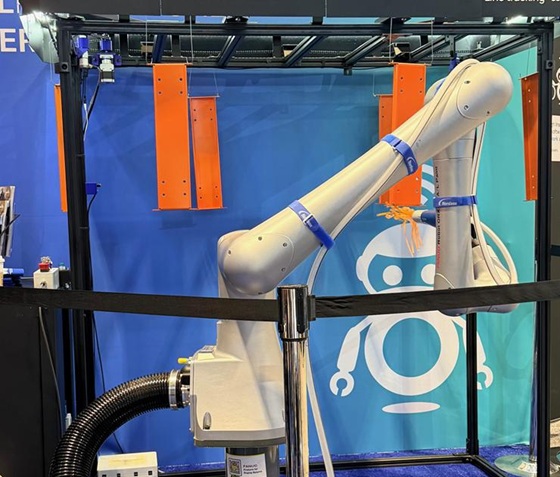
Hirebotics has expanded its collaborative robot systems with line-tracking technology for painting moving parts on conveyor systems and a modular linear rail designed to extend cobot reach for large workpieces. The company is demonstrating the technologies at IMTS 2026 in Chicago. Line tracking is being added to the Hirebotics Cobot Painter, while the linear rail is designed for use across the company’s welding, plasma-cutting and painting applications.
The line-tracking system allows the Cobot Painter to follow parts as they move along a conveyor while maintaining a programmed painting path. A sensor detects an arriving part and initiates the operation, while an encoder and sensor provide information about conveyor movement. The robot can compensate for changes in conveyor speed as it follows the workpiece through its operating area.
Setup and operation are handled through Hirebotics’ Beacon cloud-based platform. Operators can use the platform to calibrate the direction and movement of the conveyor and configure the painting operation without specialized robot programming, according to the company.
The system is intended for manufacturing environments where stopping or removing parts from an existing conveyor for painting would require additional handling or changes to production flow.
Hirebotics has also introduced a linear rail that allows its cobots to move along larger workpieces. The company’s cobots have a stated reach of 68.9 inches, which can limit their ability to work on frames, structural assemblies and weldments extending beyond the robot’s fixed work area.
The rail is available in 5-foot increments and custom lengths. It can be used with Hirebotics systems for welding, plasma cutting and painting, allowing a cobot to be repositioned along a workpiece rather than requiring the workpiece itself to be moved.
The initial version of the rail uses manual positioning. Hirebotics plans to add position verification through its Beacon platform to guide operators when changing positions. A fully automated version, designed to move the cobot between positions without manual repositioning, is planned for the end of 2026.
Matthew Bush, co-founder and CEO of Hirebotics, said the additions are intended to reduce the need for manufacturers to modify existing production processes around a robot’s fixed working envelope.
“By removing the fixed-position limitation and extending the reach of the cobots through the linear rails or the line tracker or both, manufacturers can accomplish their work without changing the experience that made these cobots approachable in the first place,” Bush said.
