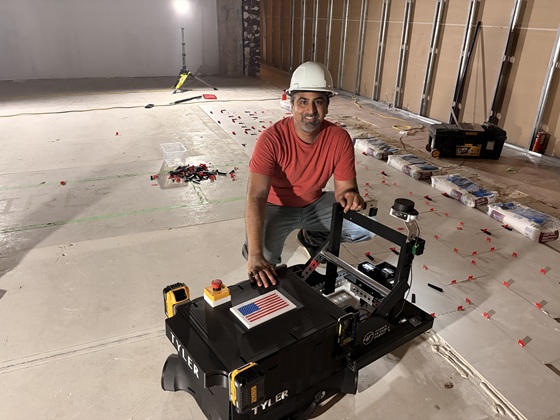
Human Friendly Robotics (HFR) has entered into a three-year contract worth up to $4 million with commercial flooring subcontractor Flooring Concepts of NJ to deploy robotic tiling systems across projects in New York, New Jersey, Pennsylvania and the greater New York City metropolitan area.
Under the agreement, HFR will provide its autonomous tiling robot, Tyler, to work alongside Flooring Concepts’ installation crews. The contracted installation capacity represents approximately 15% to 40% of Flooring Concepts’ luxury vinyl tile (LVT) installation work over the next three years.
Tyler is designed to automate repetitive tile placement tasks while human installers remain responsible for cutting, edge work, finishing and quality control. According to HFR, the system can increase tile-setting productivity by up to eight times compared with conventional manual installation methods.
The agreement operates under a service-based pricing model, allowing Flooring Concepts to pay per square foot of flooring installed rather than purchase the robotic equipment outright.
“Tyler will help us expand capacity, improve scheduling and reduce some of the hardest physical demands on our crews,” said John Pilot, president of Flooring Concepts. “Thankfully, I can just pay per square foot of install instead of purchasing the equipment.”
The companies have previously collaborated on robotic flooring installations, with Flooring Concepts incorporating Tyler into selected projects. The new contract establishes a longer-term arrangement for deploying the technology across a broader volume of commercial flooring work.
The agreement follows HFR’s addition to the Starnet Commercial Flooring network as a robotics service provider. The network comprises approximately 200 member subcontractors with combined annual sales of at least $4 billion.
The deployment comes amid labor shortages affecting the construction industry. A September 2026 survey by the Associated General Contractors of America (AGC) and the National Center for Construction Education and Research (NCCER) found that 42% of surveyed construction firms had experienced project delays because of workforce shortages.
Flooring Concepts has reported a pipeline of commercial flooring projects extending into 2028. The company intends to use robotic installation systems to increase the volume of work its existing crews can undertake while reducing the physical demands associated with repetitive kneeling, bending and tile placement.
Tyler can be operated by trained flooring installers without a background in robotics. The system can also support overnight and extended installation schedules when staffing and site conditions permit.
HFR founder and CEO Shamoon Siddiqui said the company is seeking to increase installation capacity while reducing physical strain on skilled tradespeople.
“Our customers have more work than their crews can fulfill. We give skilled professionals a tool to complete their work 8X faster, and without tiring,” Siddiqui said.
HFR reports that Tyler has already been deployed at dozens of construction sites in the New York City metropolitan area and Puerto Rico, including schools, shopping malls and government buildings.
The three-year agreement provides HFR with a contracted commercial deployment of its robotic flooring technology, while allowing Flooring Concepts to expand its use of automated installation equipment without the upfront costs of purchasing the systems.
