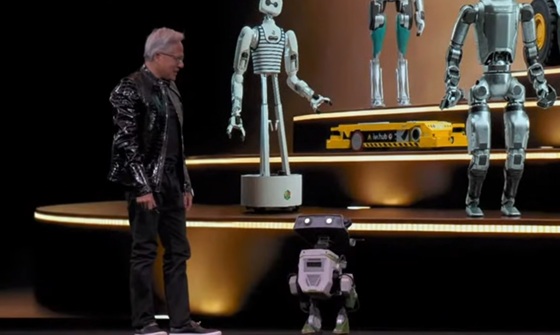
Nvidia CEO Jensen Huang has declared that artificial general intelligence has arrived following the launch of OpenAI’s new GPT-6 Astra model. His statement adds to a broader shift in the language surrounding frontier AI, with OpenAI president Greg Brockman also arguing that the industry may now have entered the “AGI era.”
“From ChatGPT to o1 to Astra in 4 years. AGI has arrived. Congratulations @OpenAI team,” Huang wrote on X on September 6, three days after OpenAI introduced Astra.
Huang also highlighted the computing infrastructure behind the model. According to the Nvidia CEO, Astra was trained using more than 100,000 Nvidia Grace Blackwell NVLink72 GPUs, with another 400,000 GPUs coming online. His comments underline Nvidia’s role as one of the main suppliers of computing infrastructure used to train and run large AI models.
OpenAI released GPT-6 Astra on September 3, describing it as its most capable model to date. The company reports major improvements in computer use, browsing, software engineering, cybersecurity, scientific work and other professional tasks.
Astra scored 98% on FrontierMath Tier 4, 99.9% on ARC-AGI-3 and 100% on ExploitBench, according to OpenAI. On an offline subset of the OSWorld 2.0 computer-use benchmark, it scored 72.6% while taking around 40 minutes per task, compared with 65.7% and approximately 75 minutes for GPT-5.6 Sol.
From chatbot to computer user
A major focus of Astra is its ability to operate software rather than only generate answers. OpenAI says the model can navigate websites, fill in forms, update CRM systems, work with spreadsheets and calendars, analyze scientific data and use professional applications.
The company is positioning these capabilities as a step toward AI systems that can carry out complete workflows with less human guidance. Instead of requiring a separate software integration for every application, an AI agent can increasingly work through the same graphical interfaces used by people.
Astra has also become OpenAI’s first broadly deployed model to reach the company’s “Critical” cybersecurity capability threshold. OpenAI says that, when supplied with the necessary tools and access, the model can identify previously unknown security vulnerabilities and develop ways of exploiting them without a person directing every individual step. The company has introduced additional restrictions and monitoring around these capabilities.
OpenAI also raises the AGI question
Huang is not alone in applying the AGI label to the new generation of models. During a briefing ahead of Astra’s launch, OpenAI president Greg Brockman said he personally believed the company had reached that point.
“For me personally, I do think we’re there,” Brockman said when asked whether Astra qualified as AGI. He concluded the briefing with the words: “Welcome to the AGI era.”
OpenAI’s formal announcement is more cautious. It does not state that the company has definitively achieved artificial general intelligence. AGI also has no universally accepted technical definition or benchmark.
OpenAI has historically described AGI as highly autonomous systems that outperform humans at most economically valuable work. Whether Astra meets that standard cannot be established solely from its performance on current benchmarks.
OpenAI CEO Sam Altman has previously described AGI as a poorly defined term, reflecting the difficulty of identifying a single technical point at which increasingly capable AI systems become “general” intelligence.
Claim draws criticism
Huang’s statement has therefore also prompted criticism. AI researcher Gary Marcus argued that declaring the arrival of AGI without defining the term or establishing a measurable threshold does not demonstrate that AGI has actually been achieved.
The debate illustrates a wider problem surrounding increasingly capable AI models. Improvements in reasoning, software use, autonomy and scientific performance can be measured individually, but there is no agreed test that determines when those capabilities collectively constitute AGI.
Huang’s statement is nevertheless notable because of its categorical wording. Rather than discussing AGI as a future milestone, the Nvidia CEO is now saying that the threshold has already been crossed. Combined with Brockman’s comments, it marks a change in how some of the companies at the center of the current AI industry are describing the capabilities of their latest systems.
Whether the wider research community adopts that assessment will depend less on the label itself than on evidence of how reliably systems such as Astra can perform a broad range of real-world tasks with limited human supervision.
GPT-6 Astra, trained on ~100K+ NVIDIA Grace Blackwell NVLink72. From ChatGPT to o1 to Astra in 4 years.
AGI has arrived. Congratulations @OpenAI team.
400K GPUs coming online next.
— Jensen Huang (@JensenHuang) September 6, 2026
