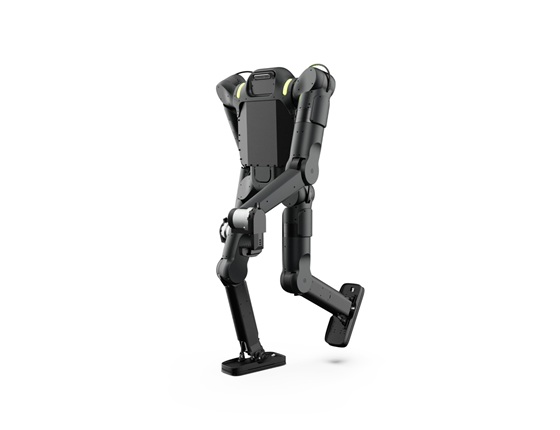
Renault Group and French robotics company Wandercraft are working toward deploying 350 humanoid robots in Renault factories in France and Spain by the end of 2027. At the Humanoid Robots Summit in Stuttgart, the companies provided a closer look at the industrial development behind the programme and highlighted robot training as one of the main obstacles to deployment at scale.
Renault’s roadmap calls for around ten robots to be in place by the end of 2026, followed by 350 across its French and Spanish factories by the end of 2027. The target itself was first disclosed by Renault earlier this year and was reiterated as the companies discussed their work at the Stuttgart summit. (renaultgroup.com)
The programme centres on Wandercraft’s Calvin humanoid platform. Renault is already testing Calvin at its Douai plant in France, where the robot is being used for tyre handling. In the current application it picks up two tyres at a time, representing a load of around 30 kilograms. Renault sees such applications as a way of taking over physically demanding and repetitive work while retaining the flexibility to use the same robot for different tasks.
In Stuttgart, Renault’s Laurent Duthoit and Wandercraft’s Camille Croze presented the development programme together. Summit moderator Martin Willers described the session as including the reveal of a new industrial humanoid design from the two companies. A field report from the event refers to the machine as a V1 co-developed with Renault, following an initial Calvin prototype that Wandercraft developed in 40 days using technology originating from its exoskeleton platform.
The presentation also put numbers on one of the less visible challenges facing industrial humanoid robotics: teaching robots new skills. According to reporting from the summit, developing a single industrial operation can currently take about six months, from collecting teleoperation data through building models and testing the behaviour in simulation. For automotive manufacturing, the companies ultimately want that process to take days or weeks rather than months.
A shortage of suitable industrial data is part of the problem. Much of the data available for training general-purpose robots comes from domestic or relatively controlled environments. Manufacturing introduces different requirements, including moving production lines, changing objects, safety constraints and the need to repeat tasks reliably over long periods.
That reliability requirement is particularly important as Renault moves beyond individual demonstrations. The car manufacturer says it already operates around 11,000 conventional industrial robots. These systems are generally designed and programmed for specific tasks, whereas the objective with Calvin is to create a mobile platform that can perceive its surroundings, adapt its behaviour and eventually switch between different assignments.
Renault says two challenges remain in the Douai trials: increasing the robot’s robustness and integrating it into a high-speed production environment. The manufacturer has therefore positioned the current deployment as a development programme rather than a replacement of conventional automation or human operators.
The Renault programme is not Wandercraft’s only route toward commercial deployment. On September 4, the company said it had secured 12 customers for Calvin-40 across automotive, logistics, retail, healthcare and defence, although it did not disclose customer names or order volumes. Wandercraft is initially focusing on material-handling tasks involving tyres, boxes, parcels, panels and carts, with picking and sorting among the capabilities now being developed. Its strategy is to establish reliable performance in clearly defined industrial tasks first, then use operational data from deployments to expand the robot’s capabilities over time. (wandercraft.eu)
Wandercraft is meanwhile preparing Calvin for broader series deployment. The company is working with Renault on manufacturing, engineering, procurement and design-to-cost as it seeks to increase production. First series deliveries are expected in the first half of 2027.
The Stuttgart presentation therefore showed both the progress and the remaining constraints around industrial humanoids. Renault and Wandercraft now have a concrete deployment target involving hundreds of robots, while Wandercraft is building a wider customer base outside the Renault programme. At the same time, reducing the time required to train new skills, improving reliability and proving that the robots can operate consistently alongside existing production systems remain important steps before deployment at that scale becomes practical.
