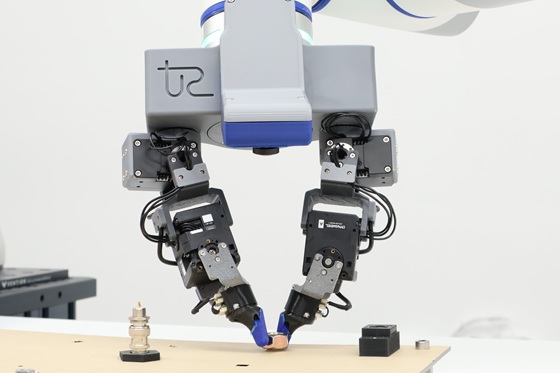
Tangent Robotics has raised $4.5 million in pre-seed funding in a round led by Fly Ventures and Toyota Ventures. The Columbia University spinoff plans to use the capital to develop robotic manipulation technology combining hand hardware, touch sensing and motor learning, with an initial focus on manufacturing applications.
The New York-based company is developing systems intended to give robots the fine motor skills required for tasks such as assembly, threading, connector mating, gasket seating, snap fitting and gear meshing. Tangent is targeting operations that require more precise manipulation than conventional robotic grippers and suction systems can provide.
Its technology combines light-based touch sensors for robotic fingers, robotic hands designed to track human fingertip movements, and machine-learning and data-collection methods. The company describes these components collectively as a fine motor skill layer for autonomous robotic manipulation.
Tangent is positioning the technology for applications including part sequencing, precision assembly, manufacturing, installation and maintenance. Potential tasks include disassembly, inspection, reassembly and the wiring of electrical or mechanical equipment.
“Fine motor skills are hard to learn, and represent a layer that is currently missing in robotics but omnipresent in the real world,” co-founder Pedro Piacenza said. “They unlock the ability to perform delicate, intricate manipulation.”
Rather than reproducing the structure of the human hand, Tangent is developing robotic hands with different mechanical designs that it says can still perform dexterous tasks. The company aims to reduce the training time required for robots to acquire such skills to days and eventually hours.
“Trying to copy the human hand is a mistake akin to building flying machines with flapping wings,” said co-founder Matei Ciocarlie, a robotics professor at Columbia Engineering. “What we can do is build robot hands that are capable of dexterity even with non-human-like components or articulation.”
Tangent was spun out of Columbia Engineering’s Robotic Manipulation and Mobility Lab. Its founding team includes Piacenza, Ciocarlie and electronics specialist Ioannis Kymissis.
The founders’ previous research at Columbia included the DISCO robotic finger, which uses light to sense touch, as well as robotic hands developed for NASA’s Assistive Free Flyer robots aboard the International Space Station. The team also developed a robotic hand designed to perform in-hand manipulation without relying on vision. Ciocarlie previously co-led the manipulation team at robotics research organization Willow Garage.
Fly Ventures partner Matt Wichrowski said conventional grippers and suction cups work for applications including picking, packing and sorting but are less suited to tasks requiring fine motor control.
Toyota Ventures partner David Sokolic said Tangent’s approach places compliance primarily in its sensing system rather than relying only on mechanical components. The company intends to apply that approach to industrial assembly tasks that remain difficult to automate.
