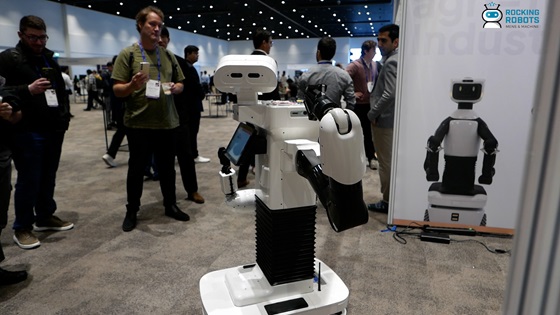
PAL Robotics has used its mobile robot TIAGo as a test platform for CoreSense, a four-year Horizon Europe project focused on robot awareness and explainable decision-making. The robot was evaluated in scenarios where it welcomes visitors, guides them to a seat and accepts personal belongings.
The CoreSense consortium developed a cognitive architecture intended to help robots explicitly model what they know about themselves, their tasks and the objects around them. Rather than requiring retraining for every situation, engineers can provide these knowledge models directly to the robot. The approach was also tested in manufacturing and drone-inspection settings.
PAL Robotics led the project’s social robotics testbed. In the trials, TIAGo combined audio and vision modules with the HEXAR explainability component. This enabled the robot not only to act, but also to communicate through speech and gestures what it was doing and why. The aim is to make robot behaviour easier for people to understand, for example when it approaches a visitor or handles an object.
The announcement concerns a completed research validation, not a commercial deployment. PAL Robotics says the project’s ROS-compatible software toolbox will remain open and maintained between 2026 and 2029.
The work is relevant because explainability becomes more important as robots operate closer to people. In healthcare, service environments and public spaces, a robot needs to do more than complete a task reliably; users and bystanders may also need to understand its actions and decision-making.
PAL Robotics is now assessing whether parts of the CoreSense architecture can be integrated into its TIAGo and ARI platforms. Other project partners are exploring follow-on pilots with manufacturers and a possible spin-off around the cognitive architecture and engineering tools.
