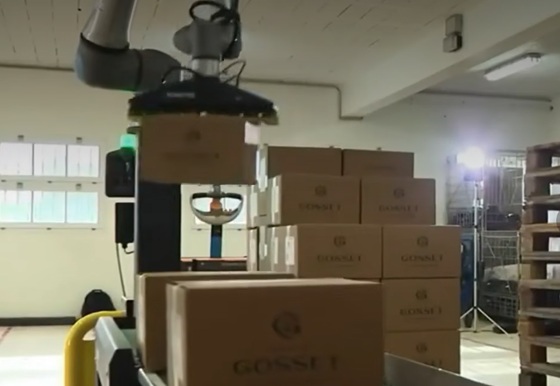
French champagne producer Gosset has introduced a collaborative robot to automate palletizing at the end of its production line. The system, developed by Robotiq and installed with local partner Sysaxes, handles different packaging formats, stacks boxes weighing up to 11.5 kilograms and operates within the limited space of an existing production facility. The project illustrates how robotic automation can be introduced into traditional manufacturing environments without fundamentally changing established production processes.
Founded in 1584, Champagne Gosset is one of France’s oldest champagne houses. The company produces approximately one million bottles annually, combining traditional champagne production methods with modern packaging and logistics operations. Until recently, the final stage of its production line depended on employees manually lifting boxes of champagne and arranging them on pallets.
The work involved repeatedly handling cases weighing up to 11.5 kilograms, bending to place boxes on lower pallet layers and reaching upwards as pallets became higher. In addition to the physical demands, employees had to maintain the pace of the production line while accommodating different bottle sizes and packaging configurations.
According to Robotiq, the repetitive lifting created ergonomic risks, particularly musculoskeletal disorders, while manual palletizing also represented a potential bottleneck in production. Gosset therefore began investigating automation, but with one important requirement: the existing production process had to remain largely unchanged.
Adapting the robot to the production line
Rather than redesigning its packaging operations around a new machine, Gosset wanted a robotic system that could accommodate its existing workflows. Several proposed automation solutions had reportedly failed to meet these requirements.
The company eventually selected Robotiq’s PE20 Lean Palletizing solution, based on a UR20 collaborative robot from Universal Robots. The robot has a reach of 1,750 millimetres and a maximum payload of 20 kilograms. Equipped with a Robotiq vacuum gripper and palletizing software, it picks up champagne cases from the conveyor and places them onto pallets according to predefined stacking patterns.
During a technical webinar about the project, Robotiq explained that this last requirement demanded a customized robot movement. Instead of gripping every box from above, the cobot sometimes picks up a case from the side or rear, lifts it and rotates it by 90 degrees before positioning it on the pallet.
This additional movement increases the cycle time, but allows Gosset to retain its existing packaging procedures. The installed system currently handles approximately six boxes per minute, corresponding to a theoretical rate of 360 boxes per hour when running continuously.
Working under a low ceiling
The physical layout of the production facility presented another challenge. Gosset’s packaging area has limited floor space and a relatively low ceiling, restricting the working envelope available to the robot.
The palletizing system was configured to build pallets up to 1.85 metres high while operating beneath a ceiling of approximately 2.5 metres. Robot movements were programmed to remain within these constraints.
The installation also supports two pallet positions and uses contact detection to enable operation without a conventional safety cage. This allows operators to work in the surrounding production area, although the necessary protective measures depend on the specific application, robot speed, payload and risk assessment.
Robotiq and Sysaxes used a three-dimensional simulation to validate the proposed configuration before installation. The simulation made it possible to assess the available space, robot movements and pallet arrangements without making substantial modifications to the production line.
From initial contact to installation in five weeks
The project also stands out for its implementation period. According to Robotiq, only five weeks passed between the initial contact with Sysaxes and the deployment of the palletizing solution.
During the webinar, Robotiq robotics solution specialist Dario explained that an implementation period of ten to twelve weeks would normally be more typical for a comparable project. At Gosset, installation and commissioning on the production line took approximately two to three days.
This included setting up the equipment, programming the required movements and training employees to manage different packaging formats.
An important part of the system is its software interface, which allows operators to create new palletizing configurations without advanced robot programming knowledge. They enter the box dimensions and weight, select the pallet type and define the desired stacking pattern through a visual interface.
The software then determines the picking positions and generates the robot movements. According to Robotiq, employees can learn to create or modify these configurations after a few hours of training.
This is particularly relevant in champagne production, where packaging may change depending on the bottle size, product range or presentation requirements.
Employees move to other tasks
Although the palletizing operation is now automated, the employee previously responsible for manually stacking boxes has remained in the production process.
Robotiq says the change has allowed staff to spend more time on quality control, finishing operations and other production activities rather than repeatedly lifting heavy cases.
Yvain Leblond, production manager at Champagne Gosset, described the team’s response to the introduction of the robot:
“We were able to get familiar with the cobot, test it and try out the different recipes. Once it was lent to us, nobody wanted to let it go.”
The statement reflects the company’s reported experience with the system, particularly its ability to remove physically demanding activities while keeping employees involved in production.
The case also highlights the importance of involving operators in the implementation of industrial robotics. Rather than requiring specialist programming personnel for routine adjustments, Gosset’s employees can manage the robot’s palletizing configurations themselves.
However, while Robotiq reports that the installation has reduced repetitive lifting and improved working conditions, the published case study does not provide independently measured reductions in injuries or absenteeism. Nor does it disclose a quantified return on investment or a before-and-after comparison of total production output.
The Gosset project demonstrates a practical application of collaborative robotics in an industry not generally associated with advanced automation. Although champagne production is closely linked to traditional craftsmanship, its packaging and logistics operations face many of the same challenges as other manufacturing sectors.
Heavy manual handling, limited production space, changing product formats and the need to maintain throughput all create opportunities for robotic automation.
For smaller manufacturers, one of the barriers to automation is the assumption that production processes must be redesigned around industrial robots. The Gosset installation illustrates a different approach, in which a relatively compact robotic workcell is adapted to existing infrastructure.
The ability to handle multiple packaging formats is particularly important. While conventional automated palletizing installations are often designed around relatively standardized products, flexible software and adaptable grippers allow collaborative robots to accommodate variations without extensive mechanical modifications.
Robotiq has also implemented palletizing applications at other wine and beverage producers, including German sparkling-wine manufacturer Raumland and French bottling company Bulles Création. These projects suggest that end-of-line palletizing is becoming an increasingly accessible application for collaborative robotics in the beverage industry.
At Gosset, the immediate outcome is the automation of a repetitive manual task that previously required employees to handle hundreds of heavy boxes during a production shift. The robot has been integrated without major changes to the company’s production methods and can be adapted to different packaging requirements by the employees themselves.
