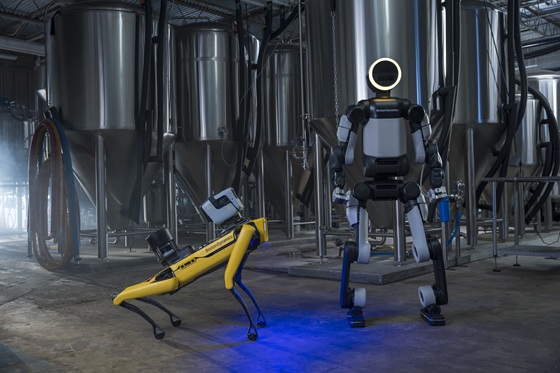
Humanoid robots are set to enter a new industrial environment as semiconductor manufacturer GlobalFoundries prepares to test Boston Dynamics’ Atlas at its production facilities. The collaboration marks the first time the Atlas early adopter program will extend beyond the automotive industry, with initial trials scheduled to begin in early 2027.
GlobalFoundries will become the first semiconductor manufacturer to participate in Boston Dynamics’ Atlas humanoid early adopter program. The companies announced the agreement on November 17 as part of an expanded robotics partnership covering manufacturing facilities in the United States, Germany and Singapore.
The move introduces humanoid robotics into an industry where manufacturing processes are highly automated, tightly controlled and dependent on continuous equipment availability. While industrial robots have long been used in semiconductor production, the companies will now investigate whether humanoid robots can perform additional tasks within these complex manufacturing environments.
Exploring humanoid applications in chip factories
Beginning in early 2027, Boston Dynamics and GlobalFoundries will conduct onsite testing of Atlas at the semiconductor manufacturer’s facilities. The initial program will focus on identifying potential applications, assessing integration requirements and training the robot to perform specific tasks.
The companies have not yet disclosed which manufacturing activities Atlas will undertake or at which facilities the first tests will take place. The program remains an evaluation rather than a confirmed commercial deployment, and no performance targets or expected fleet sizes have been announced.
The trials will also examine how humanoid robotics could fit into existing manufacturing operations. Semiconductor factories contain extensive infrastructure for processing wafers, transporting materials, maintaining equipment and monitoring production conditions. The ability of humanoid robots to operate alongside existing systems without disrupting production will be an important consideration in evaluating their potential role. For Boston Dynamics, the agreement represents an expansion of Atlas into a manufacturing sector beyond automotive production, where the company has already begun developing and testing humanoid applications.
Building on four years of robotic inspections
The Atlas initiative builds on an existing relationship between Boston Dynamics and GlobalFoundries. For more than four years, the semiconductor manufacturer has used the company’s four-legged Spot robots for automated inspections and predictive maintenance. At GlobalFoundries’ Singapore operations, two Spot robots have traveled nearly 900 kilometers and completed more than 90,000 inspections in sub-fab areas since April. According to the companies, the robots achieved a 99% mission success rate.
GlobalFoundries also reports that it reconfigured 875 routine inspections in two weeks using updated Spot hardware and software. The company plans to more than double that number by expanding the robots’ visual inspection capabilities. Spot deployments will now expand across GlobalFoundries’ manufacturing network in Malta, New York; Burlington, Vermont; Dresden, Germany; and Singapore.
“Spot has helped us shift from reactive to predictive maintenance, collecting data across thousands of inspection points to prevent downtime and keep our fabs running more efficiently,” said Pradip Singh, chief manufacturing officer at GlobalFoundries. According to Singh, expanding Spot and introducing Atlas are part of the company’s broader transition toward AI-enabled manufacturing.
A new test for physical AI
The collaboration also illustrates the different stages of industrial robotics adoption. While Spot is already performing measurable inspection work in semiconductor facilities, Atlas is entering an exploratory phase in which its practical capabilities still need to be established. For humanoid robotics, semiconductor manufacturing presents a different set of requirements from automotive assembly. Production environments demand high levels of reliability, controlled operating conditions and integration with established industrial processes.
Whether Atlas can meet these requirements, and which tasks would benefit from a humanoid form rather than conventional automation, remain open questions. The planned trials in 2027 should provide an initial indication of how Boston Dynamics intends to extend humanoid robotics into semiconductor manufacturing. For now, the agreement represents a new industrial testing program rather than evidence of humanoids already operating in chip production.
