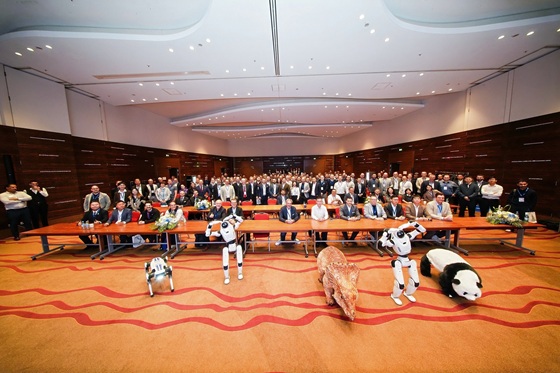
Robotics manufacturer DOBOT has introduced three new robotics platforms at its Robotics Ecosystem Conference & Product Launch 2026 in Frankfurt, Germany. With LUMO, PULSA and the CRH series, the company is expanding its portfolio for applications in service robotics, industrial automation, research and education.
The event brought together nearly 200 representatives from European manufacturing companies, system integrators, research institutions and automation specialists. A total of 18 applications covering embodied AI, industrial automation and education were demonstrated.
With LUMO, DOBOT presented an intelligent robot designed for use in domestic environments, research and education, as well as commercial service applications. The platform is based on the company’s proprietary DobotWAM embodied foundation model, which combines vision-language-action modelling with three-dimensional spatial understanding, robot motion constraints and closed-loop control using real-world data.
The new PULSA collaborative industrial robot is designed for applications including machine tending, component sorting, assembly and logistics. The platform is available in two versions with payload capacities of 7 kg and 12 kg. Repeatability is specified at ±0.02 mm for the PULSA 7 and ±0.03 mm for the PULSA 12. According to DOBOT, the maximum joint speed of the sixth axis reaches 790 degrees per second and 735 degrees per second, respectively.
For collaborative operation, PULSA incorporates more than 20 configurable safety functions. The company states that its functional safety complies with ISO 13849-1, Performance Level d, Category 3.
With the CRH series, DOBOT is expanding its range of robots for industrial applications requiring high movement speeds and short cycle times, including joining processes. The models are available with payload capacities of 7 kg and 12 kg. The maximum speed of the sixth axis is 450 degrees per second, while instantaneous tool centre point (TCP) speed reaches up to 7 metres per second.
The CRH series uses DOBOT’s HyperMove algorithm to control acceleration and deceleration and optimise motion trajectories. The system is designed to reduce vibration and mechanical stress. Internal cable routing is intended to simplify the integration of vision systems and end-of-arm tooling. Additional features include joint torque measurement and more than 30 configurable safety functions. DOBOT also reports that the series has received TÜV certification.
Beyond the new robotics platforms, the conference focused on integrated automation solutions. Participating technology partners included Siemens, SCHUNK, Mech-Mind, SICK, Piab, OnRobot, SCHMALZ and Cambrian Robotics. Demonstrations covered welding, palletising, machine tending, industrial machine vision, embodied AI and technical education.
Industrial customers Unsinn Fahrzeugtechnik and Unista shared their experiences with robotic applications in palletising and welding. Other sessions addressed technical standards, safety requirements and the adoption of physical AI in European manufacturing.
A separate Education Forum examined the use of robotics platforms in research and teaching. Participants included DOBOT and experts from institutions such as Fraunhofer, the Technical University of Munich and Tecnalia. Discussions covered robotics system interoperability, safety and the transfer of research findings into practical applications.
The three new platforms address different areas of robotics, ranging from intelligent service robots and collaborative automation to industrial processes requiring high operating speeds. The conference also provided an opportunity for robotics manufacturers, technology partners, industrial customers and research institutions to discuss the integration of robotic solutions into existing production and application environments.
