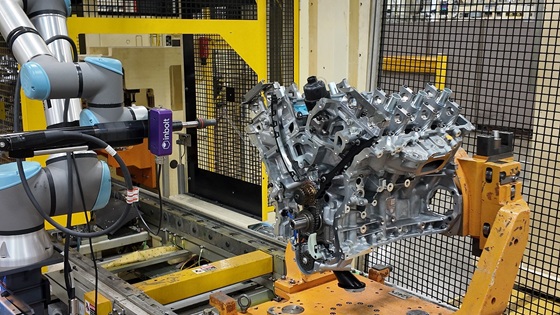
Universal Robots (UR), part of Teradyne Robotics, and French robotics software company Inbolt have integrated AI-powered 3D vision guidance directly into UR’s seventh-generation robot platform. The integration enables manufacturers to deploy vision-guided automation without an external industrial computer or additional cabling along the robot arm. Presented at the SPS automation trade show in Nuremberg, Germany, the integration allows Inbolt Standard to run natively on Universal Robots’ CB7 Core controller. The software will be sold and licensed through Universal Robots, with additional Inbolt products planned for release in the coming months.
Inbolt Standard uses a wrist-mounted 3D camera to identify components based on their CAD files, determine their position and adjust the robot’s programmed path during each production cycle. Applications include screwdriving, machine tending, rack loading and depalletizing.
The technology reduces the need for custom fixtures and jigs, allowing manufacturers to accommodate different components through software adjustments rather than mechanical modifications.
The native integration eliminates the need for a separate industrial computer to process vision data. The camera connects directly to the robot’s tool flange through integrated Ethernet and power connectors.
“Gen 7 is our platform for physical AI, giving partners the compute, connectivity and tools to develop AI applications and deploy them directly on the robot,” said Anders Billesø Beck, Vice President of AI Robotics Products at Universal Robots.
Universal Robots and Inbolt have collaborated since 2022, with jointly deployed vision-guided robotic systems operating at manufacturing facilities in Europe and North America. According to the companies, an installation at a Stellantis engine-tightening station reduced tightening failures by 91%, with vision processing taking 0.5 seconds per engine.
Beyond automotive manufacturing, the companies are targeting electronics and data center hardware production, where variations in the positioning of components can complicate automation. Applications include handling trays, enclosures and server chassis, as well as fastening and assembly operations. A single program can accommodate more than 80 part references.
Inbolt’s configuration software, Inbolt Studio, operates within Universal Robots’ PolyScope X programming environment. Component recognition is processed locally on the CB7 Core controller, with training based on CAD files taking less than 10 minutes, according to the companies. The process does not require image datasets or manual labeling, and production data remains within the manufacturing facility.
The system provides repeatability of 0.5 to 0.7 mm on stationary components and uses active infrared depth sensing to operate under varying lighting conditions.
Inbolt Standard supports Universal Robots’ g-Series models UR10g-1750, UR17g-1300 and UR18g-950 running PolyScope X 10.13 or later. It is also compatible with e-Series and UR Series robots equipped with a CB7 controller, although these models require an external camera cable.
