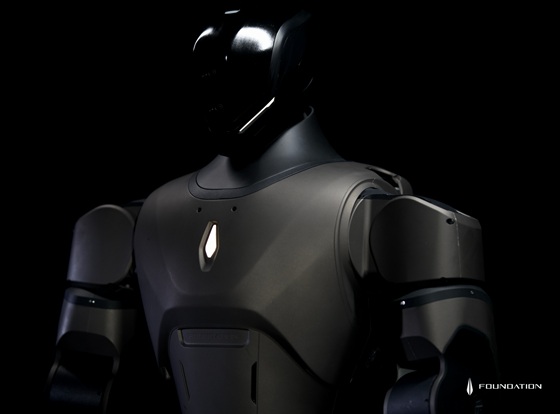
Foundation Future Industries has introduced Phantom MKII, a second-generation humanoid robot designed for physically demanding work in construction, manufacturing, logistics, mining and defence. The San Francisco-based company has also announced Cortex II, an AI platform intended to enable robots to learn industrial tasks and operate individually or as coordinated fleets. With a claimed payload capacity of 90 kilograms and a weather-resistant design, Foundation is positioning its new humanoid for applications beyond controlled factory environments.
Phantom MKII represents a redesign of Foundation’s original humanoid platform, with greater lifting capacity, improved durability and modular components intended to simplify maintenance. Rather than focusing on household assistance or consumer applications, the company is targeting industrial environments where robots must handle heavy materials, work outdoors and operate alongside existing equipment and infrastructure.
According to Foundation, the robot stands approximately 1.83 metres tall, weighs 88 kilograms and has 29 degrees of freedom. Its stated carrying capacity of 200 pounds, approximately 90 kilograms, represents a substantial increase over its predecessor. The company says the robot can carry this weight while walking, although independent verification of that performance has not been published.
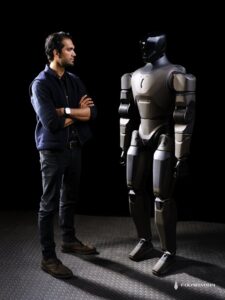
Designed for demanding environments
A central part of the development effort has been improving the robot’s mechanical systems. Foundation says it has redesigned the actuators that control the robot’s movements, reducing the size of its joints while increasing their performance. The new design also incorporates modular joints that can be replaced in the field, potentially reducing maintenance downtime.
Phantom MKII has a claimed IP67 protection rating against dust and water ingress, allowing it to operate in environments exposed to rain, dust and other challenging conditions. A 3 kWh battery provides an estimated operating time of four to six hours, depending on workload and payload.
Foundation has released footage of lifting tests and exposure to dust and water. These demonstrations provide an initial indication of the robot’s physical capabilities, although they do not establish its performance during prolonged industrial operations.
The company also says it has simplified the robot’s manufacturing process and reduced the cost of its components. Founder and CEO Sankaet Pathak told Fast Company that the redesign has approximately halved the bill of materials, an important consideration for scaling production.
Cortex II brings AI to industrial operations
Alongside the hardware, Foundation has introduced Cortex II, its next-generation AI system for controlling the humanoid.
The platform is designed to allow robots to learn physical tasks by observing human demonstrations rather than relying entirely on individually programmed movements. According to Pathak, certain tasks can be learned from as few as 60 demonstrations.
Foundation also envisions Cortex II coordinating large groups of humanoids through a common control system. Individual machines would perform assigned tasks while remaining under human supervision, potentially allowing fleets to operate across construction sites, industrial facilities and logistics networks.
The company has not yet published extensive technical documentation or independent performance results for Cortex II. Its ability to transfer learned skills between different environments and sustain autonomous operations at industrial scale therefore remains to be demonstrated.
Ambitions extend to construction and infrastructure
The introduction of Phantom MKII is accompanied by a manifesto titled Shut Up and Build, in which Pathak argues that the technology industry should direct more resources towards problems such as housing affordability, infrastructure development and industrial productivity.
He sees humanoid robotics as a potential way to address labour shortages and reduce the time and expense involved in construction. Foundation’s longer-term vision involves fleets of robots working across the construction supply chain, from materials processing to the installation of building components.
Pathak suggests that widespread robotic automation could eventually reduce the cost of constructing a home currently valued at $1 million to between $60,000 and $80,000. He also proposes using robots to construct entirely new cities.
These figures and proposals are long-term ambitions rather than demonstrated outcomes. Foundation has not presented a detailed cost model or evidence from completed robot-built housing projects supporting the projected savings.
Industrial and defence applications
Foundation is also developing Phantom for defence-related activities. Potential applications include moving supplies, handling equipment and performing work in hazardous environments where deploying human personnel would involve significant risks.
The company has previously discussed testing its first-generation robots in Ukraine. In an interview with Fast Company, Pathak said that most of Foundation’s current defence work concerns logistics, although he did not rule out future military applications involving weapons.
This dual focus on industrial and defence markets distinguishes Foundation’s strategy from that of humanoid developers concentrating primarily on factory automation, warehouse operations or commercial services.
Production planned for 2027
Foundation intends to begin manufacturing Phantom MKII in the San Francisco Bay Area in early 2027. According to Pathak, the initial objective is to produce several hundred robots before expanding production to several thousand units by the end of that year.
The introduction of Phantom MKII comes as humanoid robot developers increasingly face questions about their ability to move beyond demonstrations towards reliable commercial operations. Payload capacity and weather resistance are relevant capabilities for industrial users, but deployment will also depend on operational safety, reliability, maintenance requirements, autonomous task performance and cost.
For Foundation, the next step will be demonstrating how Phantom MKII and Cortex II perform together in sustained industrial work. The company has presented a robot designed for demanding environments and outlined plans for larger-scale manufacturing. Whether those capabilities translate into productive deployments across construction, mining and logistics will become clearer as the platform moves into practical use.
