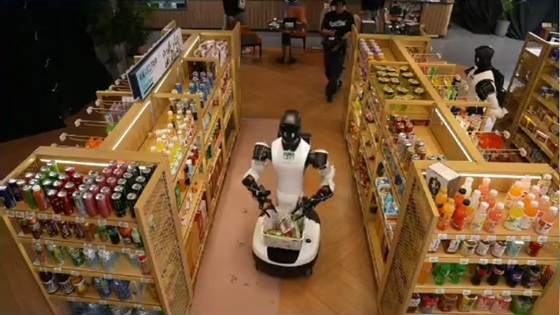
Six humanoid robots from Chinese robotics manufacturer AGIBOT have completed a 24-hour trial in a convenience store in Shanghai, carrying out a combined total of 1,730 tasks. The robots served customers, prepared coffee, restocked shelves and cleaned tables. However, only four of the six robots passed their final performance assessment, highlighting some of the challenges associated with deploying humanoid robots in everyday commercial environments.
The experiment, called ‘Robots Never Clock Out’, took place in Shanghai’s Xuhui district. AGIBOT deployed six of its wheeled Genie G2 humanoid robots in an operational convenience store, where they performed different roles throughout the lunchtime and evening peaks, overnight operations and the following morning’s breakfast rush.
According to figures published by AGIBOT, the robots completed 683 customer interactions, 369 product retrieval and delivery tasks, 277 shelf inspection and restocking tasks, 147 coffee preparations, 128 table cleaning tasks and 126 breakfast service tasks. The company says more than two million viewers watched the livestream of the experiment.
Operating in an unpredictable environment
Unlike demonstrations in controlled environments, the supermarket trial required the robots to respond to changing circumstances. Evaluators deliberately introduced unexpected situations to assess their ability to adapt. These included asking robots to distinguish between regular and sugar-free Coca-Cola, placing products in incorrect locations and obstructing an aisle.
Two robots failed to meet the performance criteria. The robot responsible for cleaning encountered an obstruction, deviated from its intended route and eventually moved outside the store without successfully returning to its assigned position.
The robot responsible for restocking shelves demonstrated insufficient initiative in identifying when products needed replenishing and struggled to keep pace with store operations. The robot serving hot food also experienced occasional difficulties manipulating objects, although it passed its overall assessment.
These shortcomings illustrate the distinction between executing individual physical tasks and independently managing responsibilities within a commercial environment. Robots must not only be capable of performing an action but also recognise when that action is required and recover from unexpected situations.
Learning from operational experience
The experiment also served as a test of AGIBOT’s Genie Master embodied AI framework. The system connects task planning, physical execution and operational feedback, using the robot’s experiences as a potential source of additional training data. Through its Embodied Execution Protocol (EEP), AGIBOT aims to create a continuous learning process in which successful actions, errors and corrections contribute to subsequent improvements in robot performance. This approach addresses one of the challenges facing physical AI developers: collecting sufficient training data that reflects the complexity and variability of real-world environments.
While the experiment provides insight into the capabilities and limitations of humanoid robots in retail, AGIBOT has not published detailed figures on the frequency of human intervention, the extent of teleoperation, overall task success rates or operating costs. Nor has the company provided a direct productivity comparison with human employees. The results, which are based on AGIBOT’s own reporting, therefore represent an operational trial rather than evidence of commercially viable autonomous supermarket operations.
