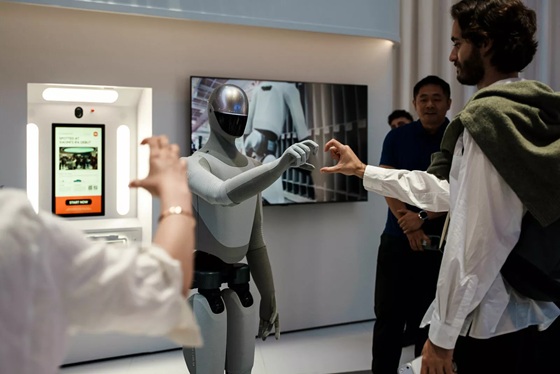
AI, household robots and autonomous outdoor machines have been recurring themes at IFA 2026 in Berlin, where manufacturers have shown how connected technology is moving beyond individual smart devices toward more automated home environments. The trade show, which runs from September 4 to 8, has included applications ranging from AI-assisted cooking and laundry to cleaning robots, mobile assistants and autonomous lawnmowers.
A central theme throughout the event has been the use of AI to reduce the number of decisions users need to make when operating household appliances. Rather than adding more settings and functions, manufacturers are increasingly looking at systems that can interpret sensor data and automatically adjust their operation.
During a keynote, Miele Executive Director and co-proprietor Dr. Markus Miele outlined how this could work for household appliances. Future washing machines, for example, could use sensors and AI to identify laundry items, colors and fabrics before selecting an appropriate washing cycle. Similar developments are taking place in kitchens, where connected appliances are being designed to adapt cooking processes to the food being prepared and the needs of individual users.
A panel involving representatives from Miele, Tate & Lyle and BSH Home Appliances discussed how AI and appliance data could simplify food preparation. According to the participants, the focus is shifting away from presenting consumers with large numbers of programs and settings and toward automating more of the underlying process.
AI is also increasingly being linked to health and assisted living. Speakers at IFA discussed how data from household appliances, wearables and other devices could eventually be combined to support personalised nutrition or help older people continue living independently. These applications remain dependent on questions around privacy, data management and user control.
Robots move further into the home
Robotics formed another part of this development. Cooking and cleaning robots are already among the most established categories, but companies are also experimenting with more general-purpose mobile assistants and humanoid robots.
At IFA, these systems were presented as potential tools for tasks including food preparation, cleaning, monitoring and other household activities. Many of the broader applications discussed remain prospective rather than widely deployed consumer products, however. Safety, reliability, cost and social acceptance will determine how quickly more advanced household robots move beyond demonstrations and early products.
The wider trend is toward combining robotics with sensors, AI and connected appliances. Instead of operating as isolated machines, future robots could become part of a broader home automation system that shares information between appliances and other devices.
This shift also raises questions about how much autonomy users are prepared to hand over to their homes. Panels on human-centred smart-home design repeatedly returned to transparency, privacy and the ability of users to retain control over automated systems.
Autonomous machines move into the garden
IFA 2026 also extended its smart-home focus outdoors through its Outdoor Cooking & Gardening area.
Autonomous robotic lawnmowers were among the more visible examples. These machines increasingly combine navigation technology, sensors and software to maintain lawns with limited human intervention. Smart irrigation systems can meanwhile adjust watering according to conditions, while connected sensors provide information on weather and soil.
The same principle seen inside the home is therefore appearing outdoors: devices are being designed not simply to be remotely connected, but to interpret information and perform tasks automatically.
Energy and resource use were another part of the discussion. Connected irrigation can reduce unnecessary water consumption, while household automation can potentially adjust appliance operation according to actual demand.
Across the five days of IFA, the direction of development has been relatively consistent. AI is increasingly moving from a separate software feature into appliances, sensors and robots that operate in the physical environment. The more ambitious vision is a home in which many routine decisions and tasks are handled in the background.
