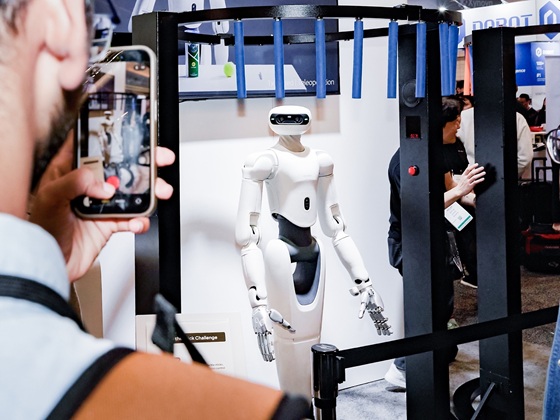
Dexterous hands, tactile sensors and new ways to collect robot training data are emerging as recurring themes at IROS 2026 in Pittsburgh. Sharpa, LumiBot and Daimon Robotics are among the companies using the conference to demonstrate technology aimed at giving robots more precise control over physical interaction. Their announcements point to a broader shift in physical AI: from recognising the world primarily through cameras towards systems that can also measure contact, force and slip — and turn those interactions into training data.
For much of the recent development of embodied AI, attention has focused on foundation models and vision-language-action systems. At IROS, several robotics companies are putting more emphasis on what happens at the point where a robot actually touches an object.
Sharpa is showing an integrated manipulation robot, a new dexterous hand and a data glove. LumiBot is combining dexterous hands and visuo-tactile sensors with an infrastructure for collecting manipulation data. Daimon Robotics, meanwhile, is presenting a stack that links tactile sensors, physical interaction data and a world model.
Although the companies approach the problem differently, all three are addressing a similar limitation: manipulation models can only learn so much from images when successful execution also depends on properties such as pressure, friction, deformation and contact.
Sharpa combines robot, tactile hand and data glove
Sharpa introduced three products at IROS: the D01 manipulation robot, W02 dexterous hand and AE01 data glove. Together, they cover robot execution, tactile perception and the collection of human demonstration data.
The D01 combines two seven-degree-of-freedom arms with Sharpa’s Wave dexterous hands and electronic skin covering the robot body. According to the company, the robot reaches an end-effector speed above 10.5 metres per second, operates at a communication frequency of 1,000 Hz and has repeatability of 0.2 millimetres. Its electronic skin samples tactile information at 100 Hz with a stated force resolution of 0.2 newtons.
Alongside the robot, Sharpa introduced the W02, a hand with 21 active degrees of freedom and a weight below 750 grams. The hand combines fingertip tactile arrays with electronic skin across the fingers and palm. Sharpa says the fingertip sensors cover forces ranging from 5 millinewtons to 30 newtons at a spatial resolution of one millimetre. The hand is designed to manipulate small and slender objects and carries an IP54 rating.
The AE01 data glove addresses the other side of the learning process. It uses 22 encoders to capture hand movement for teleoperation and demonstration recording. Operators receive vibrotactile feedback through the fingertips, while the captured motion can be translated into robot actions or stored as training data.
This combination reflects a wider development in robot learning. Hardware is increasingly being designed not only to perform tasks, but also to generate the datasets needed to improve future models.
LumiBot targets the data bottleneck
That data problem is central to LumiBot’s presentation at IROS. The startup, founded in 2025 and also known in China as Shiyue Technology, is showing its Lumi-Dex dexterous hands, Lumi-Tac tactile sensors, Lumi-Mind manipulation model and a pipeline for collecting training data.
LumiBot argues that the quality of embodied-AI datasets depends heavily on the reliability of the hardware used to generate them. The company says publicly available multimodal manipulation datasets involving high-degree-of-freedom dexterous hands and tactile sensing remain limited compared with the amount of physical experience that would be required to train large-scale general-purpose manipulation systems.
Its response is to treat the hand, tactile sensor, data pipeline and model as one system.
At IROS, LumiBot is demonstrating the Lumi-Dex-21 hand and previewing another hand designed for longer continuous operation. The company says an internally developed active-cooling joint module keeps operating temperatures around 50 degrees Celsius and supports more than 5,000 hours of continuous no-load operation.
The second component is tactile perception. Lumi-Tac V2 is a visuo-tactile sensor designed to cover different parts of the fingertip. LumiBot lists a spatial resolution of 10 microns, force-detection accuracy of 0.02 newtons and a capture rate of 120 frames per second.
Data from the hardware can subsequently be used by the company’s Lumi-Mind foundation model. LumiBot describes this as a Vision-Tactile-Language-Action system that combines multiple sensory inputs and uses tactile feedback for adjustments during contact-rich manipulation. Its Lumi-Cap pipeline links egocentric video, teleoperation and automated data processing.
During IROS, the company demonstrated a Lumi-Dex-11 hand performing a multi-stage task involving picking up a stamp, stamping, moving a tray and handing over a card. LumiBot reports that the system adjusted its planning when humans disturbed the task. The demonstration was presented by the company rather than as the result of an independent benchmark.
Daimon connects touch to world models
Daimon Robotics is taking a similar full-stack approach, but with tactile intelligence as the starting point. The company is presenting what it describes as an infrastructure connecting perception, data collection and a tactile-grounded world model.
At the perception layer, Daimon’s DM-Tac series uses vision-based tactile sensors. The company says its sensors capture more than twelve tactile modalities using more than 110,000 sensing units. Demonstrations at IROS include sensing underwater, durability tests and detecting empty packaging.
The next layer is Data-Nexus, a system bringing together acquisition hardware, networking, data processing and evaluation. Its purpose is to continuously produce physical-interaction data that can subsequently be used to train models.
At the top of the stack sits Daimon-TWM, the company’s tactile world model. Rather than relying only on visual observations, the model incorporates physical interaction data to predict and control manipulation. IROS 2026 marks the first public in-person demonstration of the system since its launch in August.
Daimon demonstrated the model with two autonomous tasks. In one, a robot picks up small engraved beads and threads them onto a flexible string. In another, it performs several stages of heat-transfer printing on a canvas bag, including positioning material, removing film and applying pressure. According to Daimon, tactile feedback allows the system to adjust its behaviour as contact conditions change.
Physical AI moves closer to the point of contact
Taken together, the three announcements illustrate where part of the physical-AI field is heading. Better models remain important, but manipulation increasingly depends on an entire chain extending from sensors and robot hands to data collection and learning architectures.
Vision can tell a robot where an object is and provide clues about its shape. It is less suited to determining whether an object is beginning to slip, how much pressure is being applied or how a flexible material reacts during manipulation. That information only becomes available once the robot interacts with the object.
The resulting challenge is therefore both a sensing problem and a data problem. Adding tactile sensors can provide richer observations, but those observations must also be collected consistently, synchronized with robot actions and incorporated into training pipelines.
