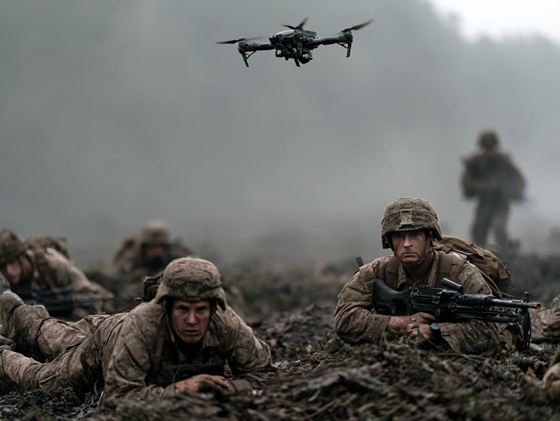
The United Nations has ended another round of negotiations on lethal autonomous weapons without securing agreement on legally binding international rules. At a conference in Geneva, 128 countries agreed to continue developing an international instrument to regulate weapons capable of selecting and attacking targets without direct human intervention. However, disagreements among major military powers prevented governments from committing to a binding treaty. The outcome highlights a growing challenge for international security: advances in artificial intelligence and autonomous robotics are changing military capabilities faster than governments can agree on how to regulate them.
After more than a decade of discussions, the regulation of autonomous weapons remains unresolved. The Seventh Review Conference of the Convention on Certain Conventional Weapons (CCW), held in Geneva from 16 to 21 November 2026, was intended to provide a new direction for international negotiations. With autonomous technologies becoming increasingly relevant to modern warfare, the United Nations had identified the conference as an opportunity to establish stronger international safeguards. However, the final agreement fell short of that objective. Countries will continue negotiations during 2027 and 2028, working towards an international instrument addressing lethal autonomous weapons systems, commonly known as killer robots. Whether the resulting document will impose legally binding obligations remains undecided.
The compromise emerged after negotiations continued into the early hours of Saturday morning. Although around 100 countries supported developing binding international rules, opposition from major military powers, including the United States, Russia and Israel, prevented agreement on that approach. Swiss Ambassador Julien Thöni, who chaired the conference, described the outcome as a significant achievement for international disarmament diplomacy. Human rights organisations were considerably less satisfied, warning that another two years of negotiations could allow military technologies to develop further without dedicated international restrictions.
When machines select their own targets
The term killer robot often suggests a humanoid machine carrying weapons, but the technological reality is considerably broader. Lethal autonomous weapons systems can include drones, robotic ground vehicles, maritime platforms and automated defensive systems that identify, select and engage targets with varying degrees of independence from human operators. The defining issue is not the physical appearance of the weapon, but the relationship between automated decision-making and human control.
Modern military systems already use sophisticated sensors, computer vision, machine learning and automated targeting software. These technologies can help identify objects, track movements and process information much faster than human operators. In some applications, automated systems can also respond to threats within extremely short timeframes. The distinction becomes particularly important when a system moves beyond supporting human decisions and begins making targeting decisions itself. A remotely operated drone, for example, may rely on AI to identify potential targets while requiring a human operator to authorise an attack. A more autonomous system may instead operate within predefined parameters, searching for and engaging targets without a separate human decision for every use of force.
These different levels of autonomy complicate international regulation. There is no universally accepted technical boundary at which an automated weapon becomes a lethal autonomous weapons system. The degree of human involvement, the operational environment and the predictability of the system’s behaviour all influence the discussion. As a result, governments are not simply debating whether autonomous weapons should be permitted, but also how such systems should be defined and under what circumstances their use might be restricted.
Human control at the centre of negotiations
One of the main questions facing governments is how much human control must be maintained over lethal force. The discussion extends beyond whether a person presses a button before an attack. It also concerns whether human operators understand the system’s capabilities, can anticipate its behaviour and have sufficient information to assess the consequences of its actions. This becomes more difficult as AI systems operate in increasingly complex environments.
A machine-learning system trained to recognise military vehicles, for example, may perform well under familiar conditions but encounter difficulties when visibility changes, objects are partially obscured or unfamiliar equipment appears. Similar challenges are well documented in civilian robotics, where lighting, changing surroundings and unexpected interactions can affect perception and decision-making. In a warehouse, a robotic error might disrupt operations or damage goods. In a military environment, comparable failures can have much more serious consequences, particularly when an autonomous system is authorised to use lethal force.
Another concern involves the speed of autonomous decision-making. Systems designed to respond quickly may leave human operators with limited opportunities to evaluate or override individual actions. Even when a human remains formally responsible for a weapon, effective control may be difficult if the system operates faster than its operator can meaningfully assess. The international discussions therefore focus not only on prohibiting certain types of weapons, but also on establishing restrictions concerning their development, deployment and operation. Possible measures include requirements for human supervision, predictable behaviour, operational limitations and procedures for evaluating whether a system complies with international humanitarian law.
Military AI develops faster than regulation
The debate has become more urgent as autonomous technologies gain importance in contemporary conflicts. The war in Ukraine has demonstrated the expanding use of unmanned systems, AI-assisted targeting and autonomous navigation. Military organisations are also developing systems intended to operate when communication links are disrupted, making it difficult or impossible for operators to control every movement remotely. This has increased interest in technologies capable of performing navigation, reconnaissance and other military tasks with less continuous human involvement.
However, not every drone equipped with AI qualifies as a fully autonomous weapon. Many systems still depend on human operators for target selection or attack authorisation, while others use autonomy primarily for navigation, obstacle avoidance or maintaining a course towards their destination. These distinctions matter when assessing claims about the battlefield deployment of killer robots. Public reporting frequently groups together technologies with substantially different levels of autonomy, while detailed information about military targeting procedures is often unavailable.
Nevertheless, advances in perception, onboard computing, machine learning and robotic control are making increasingly autonomous systems technically feasible. Developments originating in civilian robotics also contribute to these capabilities. Computer vision, autonomous navigation and AI-based planning are used across industrial automation, logistics, service robotics and military applications. Although civilian and military systems operate under very different requirements, they share several underlying technical challenges, including interpreting sensor data, responding to unexpected situations, making decisions under uncertainty and ensuring that autonomous behaviour remains within defined limits.
Why governments remain divided
Despite widespread recognition that autonomous weapons raise legal and operational questions, countries disagree about how international regulation should develop. A large group of states supports a legally binding agreement that would prohibit certain categories of autonomous weapons while regulating the development and use of others. Humanitarian organisations, including the International Committee of the Red Cross and the Stop Killer Robots campaign, have also advocated this approach. Other governments prefer to rely on existing international humanitarian law, national rules and operational safeguards rather than adopting a new binding treaty.
The United States and Russia have been among the major military powers opposing the proposed binding approach, while Israel has also resisted it. Their positions contributed to the weaker compromise adopted in Geneva. The disagreement concerns both legal obligations and military capabilities. Autonomous technologies are increasingly important to defence planning, and governments are reluctant to accept restrictions that could affect systems they are developing or consider operationally necessary.
There are also practical difficulties in defining and verifying compliance with any future agreement. Unlike a conventional weapon that can be identified by its physical characteristics, a robotic system’s degree of autonomy may depend on software, operational settings and the extent of human supervision. The same underlying platform might therefore operate under different levels of human control depending on its configuration and mission. This creates regulatory challenges that are closely connected to developments in software-defined robotics and artificial intelligence.
Under the CCW framework, decisions require consensus. That gives individual participating countries considerable influence over the outcome, even when a large majority supports stronger measures. As a result, the negotiations have repeatedly struggled to move beyond discussions of principles and possible regulatory provisions. The Geneva conference demonstrated that the political obstacles remain substantial, despite years of technical and legal discussions.
The Netherlands helped prepare the groundwork
The Netherlands played an important role in the negotiations leading up to the November conference. Dutch Ambassador for Disarmament Robert in den Bosch chaired the Group of Governmental Experts on Lethal Autonomous Weapons Systems during its 2024–2026 mandate. Working with representatives from countries including China, India, Israel, Russia, the United States and South Korea, the group examined possible elements of an international instrument.
In September 2026, the experts reached consensus on a report outlining potential provisions for the regulation of autonomous weapons. According to the Dutch Ministry of Defence, the document provided greater clarity about the characteristics of autonomous weapons systems, the circumstances in which particular systems should be prohibited or restricted, and responsibility for their use. The document did not establish binding legal obligations, but provided a foundation for political negotiations at the November review conference.
The agreement reached by the expert group demonstrated that governments could find common ground on aspects of the technology and its regulation. However, the Geneva conference also showed that agreeing on technical and legal principles is different from accepting binding international commitments. Despite the groundwork laid during the preceding two years, governments were unable to agree on a negotiating mandate that would guarantee a legally binding outcome.
What the debate means for robotics developers
For the wider robotics industry, the negotiations illustrate challenges that extend beyond autonomous weapons. As robots acquire greater decision-making capabilities, questions about reliability, predictability, transparency and human supervision become increasingly important. These issues are already central to the development of autonomous mobile robots, industrial systems and emerging humanoid platforms. However, there are fundamental differences between civilian robotics safety and the regulation of military force.
A warehouse robot must navigate safely around employees and equipment. An autonomous weapons system must additionally operate within the legal framework governing armed conflict, including requirements concerning the distinction between civilian and military targets, proportionality and precautions in attack. Compliance with those obligations cannot be established simply by demonstrating that an AI system recognises objects accurately under laboratory conditions. Developers must also consider what happens when a system encounters situations outside its training data, when sensors provide incomplete information or when different software components produce conflicting assessments.
The increasing use of machine-learning systems raises further questions about how autonomous decisions can be tested, explained and investigated afterwards. When a system makes an incorrect decision, investigators need to understand what happened and determine the roles of operators, designers and military commanders. International humanitarian law continues to apply regardless of the technology involved, but the growing complexity of autonomous systems can make it more difficult to establish how individual decisions were made and whether operators exercised appropriate control.
The negotiations in Geneva therefore reflect a broader technological development. Robots are becoming capable of performing increasingly complex tasks independently, while institutions must determine how that independence can be governed. The questions surrounding autonomous weapons are particularly consequential because the decisions involved may directly affect human lives, but the underlying challenges of oversight, accountability and predictable machine behaviour are also relevant to civilian robotics.
Two more years of negotiations
The agreement reached in Geneva establishes a further two-year process for developing an international instrument on lethal autonomous weapons systems. For governments supporting binding restrictions, the challenge will be to translate the existing technical and legal groundwork into commitments acceptable to participating states. For countries opposing a treaty, the discussions offer another opportunity to advance alternative approaches based on national regulation and existing legal obligations.
Some observers have suggested pursuing negotiations outside the CCW framework if the requirement for consensus continues to prevent a binding agreement. Similar approaches have been used in other areas of international weapons regulation, allowing countries supporting stronger restrictions to negotiate without requiring agreement from every major military power. For now, however, the Geneva conference has produced a mandate to continue negotiations rather than a new set of enforceable international rules.
Meanwhile, the technologies involved continue to evolve. Autonomous navigation, AI-based perception, robotic decision-making and increasingly capable onboard computing are expanding the possibilities for military systems, even as governments disagree over their appropriate use. Whether the next two years will produce a binding international framework remains uncertain. The underlying question is how responsibility and human control can be maintained when machines are capable of making increasingly complex decisions independently.
